Stocks, Flows, and the Degradation of the Russian Armed Forces in Ukraine (or lack thereof)
The idea that supplying the Ukrainian military will degrade Russia’s military has been a prominent justification for Western provision of military aid to Ukraine. Secretary of Defense Lloyd Austin claimed in a February 2022 press conference that the United States is aiding Ukraine because it would like to see a “weakened” Russia. The Rand Corporation, in its analysis of the path of the war, lists as a potential benefit of a long war the sustained “weakening” of Russia’s military. A recent Pentagon press release ominously notes the deaths of 300,000 Russian soldiers in the war, suggesting that such casualties reduce Russia’s military power and revise the European balance of power in favor of the United States and its allies.
The reasoning behind the hypothesis that extended war in Ukraine makes Russia weaker is simple: if Russia loses people and materiel fighting in Ukraine, then the former will have a smaller and less well-equipped military to fight or threaten future military action. This is an understandable intuition, but I would like to suggest that it is based on a mistaken understanding of military power as a stock rather than a flow.
In economics and accounting, a distinction is drawn between quantities that represent a stock: the amount of something that exists at a fixed point in time; and flows: the rate at which the quantity of something changes over a given period of time. For example, a balance sheet depicts a set of stocks: a snapshot of a business’s assets and liabilities existing at the present. On the other hand, an income statement depicts the amount of money that a business brings in over a certain period of time. A more common-sense example would be the difference between a car’s gas tank fill level and its mileage per gallon. The standard display in cars traditionally shows how much gas the car has in its tank right now (a stock), whereas some modern displays also show how much gas the car is expending based on how it is travelling right now (a flow).
During peacetime, we typically think of military power in terms of stocks.1 We count things like a military’s number of active-duty troops or how many tanks and strike fighters it currently possesses. A good reason for this is that during peacetime, that is the usually the only kind of information we have. While militaries can and do construct new systems and recruit new soldiers in order to replace ageing or technologically-out-of-date stocks, or even in order to grow their militaries2–such rates represent only the speed that a state requires to replace its stocks as they age out–not the maximum speed at which a state could in theory replace casualties, destroyed systems, and expended ammunition. For example, although most militarily active states maintain production lines for ammunition, the extent of such production lines represents merely what’s required for topping up minor depletions of peacetime ammunition from expenditures like training exercises—not the maximum amount of ammunition that a state could produce if it was constantly expending massive amounts of ammunition in a war.
While it may be justifiable to resort to using stocks as a heuristic to evaluate states’ military power during periods of peacetime (since reliable information about flows is not available), one should not assume that stocks accurately represent how much military power a state has. One way to build the proper intuitions about this is to look at works of military history. Opening any random military or even general history of a war between two industrialized states, one will rarely find (except at the points in the work describing the beginning of the conflict) information about how many troops and how much ammunition, vehicles, and other military systemс that a state has at a specific point in time. Instead, historians will typically focus on flows: they will mention facts like how many casualties the state is taking per month and how much materiel its factories are producing to replace destroyed or expended supplies.
I suspect the reason that historians choose to focus on these flow quantities, rather than static stocks, is that in an extended conflict, it is actually the relative balance of flows that can be more important in determining the outcomes of extended industrial wars. Unless one state is able to force its adversary to capitulate immediately, then the degree of military power that that state possesses over its adversary will be based on how much faster or slower it can replace its casualties and supply new materiel to the front. Extended industrial combat is typically so costly and destructive that a state’s entire initial stock of troops and materiel will be destroyed at some point in the war such that the state’s ability to prosecute the war will depend not only (and as time goes on, increasingly not at all) on how big this initial stock was but much more so on how fast it can recruit and equip replacements for exhausted forces.
In fact, precisely this outcome happened to Russia, with 90% of its initial invasion force being destroyed. But even this scale of destruction was not sufficient to prevent Russia from fighting—because its military had sufficient flows to provide new forces to make up the losses.
Once we see how much the flow of militarily relevant quantities of troops and materiel determines the outcomes of war rather than initial stocks, the assumption that reducing a state’s stock of troops or materiel can change long-run balances of power looks less compelling. Even if you can inflict casualties and destroy vehicles, if a state maintains or can develop high enough flow rates to replace these losses, then the casualties and destruction will not actually lower its long-run military power. Unless the state loses enough people and equipment to capitulate, its flow rates can make up for any losses caused at a specific point in time.
So far, I’ve discussed stocks vs flows as heuristics for military power entirely in the abstract, but my ultimate intention is to apply the distinction to explain why it’s mistaken to think that supplying military aid to Ukraine will make Russia’s military weaker. One reason we can be confident that this view is mistaken is simply that it has already been empirically refuted. Supreme Allied Commander Europe General Christopher G. Cavoli testified to Congress3 in April that Russia’s military is more powerful today than when the war began. General Cavoli’s words are worth quoting in full:
Russia is on track to command the largest military on the continent and a defense industrial complex capable of generating substantial amounts of ammunition and materiel in support of large-scale combat operations. Regardless of the outcome of the war in Ukraine, Russia will be larger, more lethal, and angrier with the West than when it invaded.
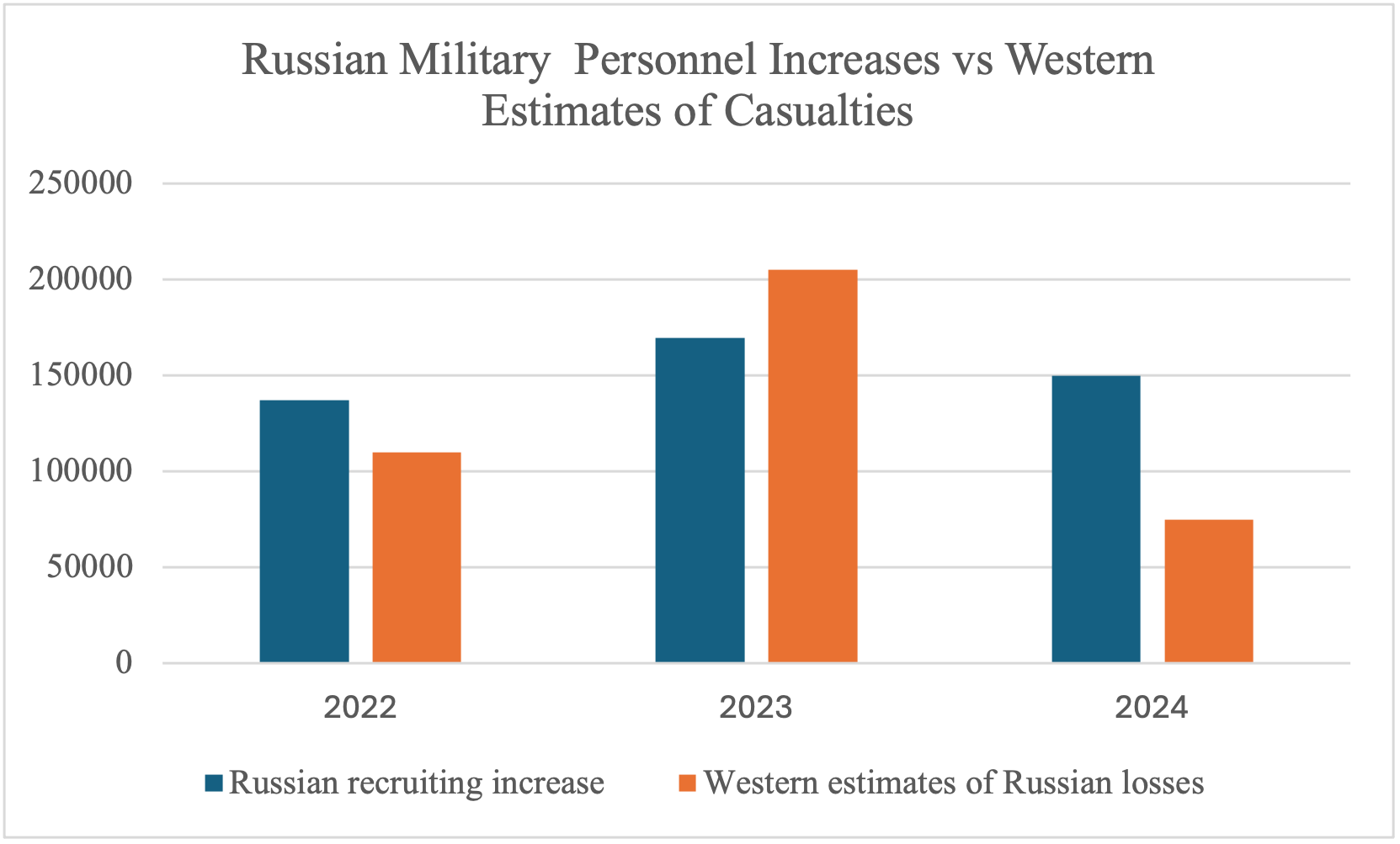
A simple chart tells the same story:
2025 Addendum: We now have another quote from a highly-placed General saying essentially the same thing as Gen. Cavoli…Russia’s military is stronger now than it was before the war:
US Air Force general: Russia military larger, better than before Ukraine invasion
Here we have unequivocal evidence—interpreted by the best-informed officials in the U.S. government—that supplying Ukraine in the war has not only failed to weaken Russia but actually produced the opposite outcome. Understanding military power as a flow, as the General alludes to when he invokes Russia’s “defense industrial complex,” tells us why this happened. Although American and Western aid may have helped inflict casualties on the Russian military, Russia has been able to replace their casualties and destroyed systems by recruiting new troops and building new systems. And not only have they done so at a sufficient rate to replace the casualties caused by Western aid, but they have even managed to expand their military and make it more lethal while fighting the war. Even though Western military aid has decreased Russia’s 2022 stocks of military power, it has increased their corresponding flows, rendering the Russian military more powerful in the long run.
One reason to think that military aid to Ukraine still weakens Russia, even though its military flow rates have been sufficient to exceed losses inflicted by such aid, is that maintaining such flows is costly and financially unsustainable for Russia. But the prediction that Russia will bankrupt itself through military spending, as some argue the Soviet Union did at the end of the Cold War, would have to be based on deep ignorance of the Russian economy. At the height of the war in 2023, Russia spent only 5.86% of its GDP on defense—not much more than the United States’ 3.5% and a far cry from the clearly unsustainable numbers around 20% that the USSR was spending in the 80s.
But even defense spending to GDP ratios don’t capture the full story. Prior to 2022, Russia ran a $15 billion budget surplus, even as its economy was recovering from the pandemic. Arguably, the large stimulus provided by increased military spending was exactly the medicine the Russian economy needed in 2022, a point which can be go beyond mere speculation when we note that Russia’s growth rates have increased since the beginning of the war. While it is true that there is such a thing as unsustainable levels of military spending, Russia appears to be in no danger of reaching such dangerous levels, and the stimulus provided by increasing its military flow rates seems to have actually been a helpful headwind for Russian growth.
If military aid to Ukraine has failed to reduce the size or strength of the Russian military, has actually made it bigger and stronger, and does not present real economic difficulties for Russia, then we can dismiss the claims by American officials and foreign policy commentators from the beginning of the war that such aid could be justified because it will make Russia weaker. It is a simple fact (as long as one believes the testimony of our military officials) that Russia’s military is stronger now than it was in February 2022, and the Russian economy is in no danger of collapse.
I believe the main reason these officials made such a mistake, to the extent that such views were propounded in good faith, was that they were not thinking of military power in terms of flows. The reason we can be almost certain of this is that at no point did the United States or any of its allies provide the kind of weapons that could have degraded Russia’s military-industrial complex and thereby its ability to generate flows; instead all of the weapons they provided were relatively short-range systems that could only enable the VSU to destroy current Russian stocks of troops and materiel. But our officials imagined Russia’s military power as a stock, and they thought that if military aid could reduce that stock, then Russia would be weaker. As a result, they failed to anticipate that without the damaging Russia’s military industrial complex or inflicting casualties in greater number than the massive 140 million-strong Russian population can sustain, it would be impossible to prevent Russia from replacing its lost forces and becoming more experienced and battle-tested in the process.
There are of course many reasons to support aid to Ukraine. Perhaps some would wish to invoke the “liberal international order” and Munich 1938 rather than the realist considerations I discuss above. My point is not so much to arrive at a definitive conclusion about the wisdom of military aid but rather to equip skeptics and opponents with a response to a prominent argument used in its favor.
I also hope the reader can see that although the U.S. foreign policy establishment often styles itself as the “adults in the room,” they made a major mistake in predicting that an extended war in Ukraine would weaken Russia. They made this mistake because of a relatively crude stock-based view of military power, which basic examination of military history would have refuted. Hopefully this episode will encourage the American foreign policy establishment and its supporters to adopt a tone of greater humility towards those who propose alternatives to their disastrous decisions.
It is this last point which I would really like to emphasize. I have had a lot of conversations in which I bring up things like the fact that Ukraine isn’t having elections anymore, only to be told that such developments don’t matter because the plan all along was to use Ukraine to degrade the Russian military, so Washington citing the imperative to defend democracy was nothing more than a rhetorical flourish to justify the means necessary to achieve this aim. But what I hope this post makes clear is that the case for military aid to Ukraine degrading the Russian military never made any sense, and if such an objective was ever an important part of the justification for our policy in Ukraine, Western officials made an enormous mistake by failing to consider how Russian military flows would regenerate destroyed stocks.
If you want to defend the fact that we are providing military aid to Ukraine, then it’s best to admit that you have some version of a Wilsonian or liberal view of international relations and that Ukraine’s lack of committment to democracy or the rule of law is a serious problem for that view. Pretending that there was always some realist case for aid is impossible based on the undeniable and predictable fact that Russia’s military is stronger today than it was in Feburary 2022.
-
A prominent counterexample to this is the CIA World Factbook listing for each state the number of male citizens who turn 18 each year. Although this is impressive and smart, I would argue that such information typically does not make it into policy discourse evaluating the military power of states. ↩
-
Or in the case of a state growing its military—these observations only tell us the speed that a state has decided to execute such growth, and not its maximum potential to produce materiel and recruit new soldiers. ↩
-
Some defenders of our policy in Ukraine have argued to me that we should not credit the public statements of American military officials because their statements are attempts to shape the information environment rather than accurate reports of how they understand reality on the ground. My response to this is that these statements were delivered under oath as testimony to Congress, rendering any willful misrepresentation a felony. There is no exception in the federal perjury statute for information warfare. I therefore find it extremely unlikely that these statements do not represent these officials’ true understanding of the Russian military’s strength. ↩
-
I compiled this chart from Russian MO published numbers for recruiting and publicly-leaked Western intelligence estimates of Russian casualties near the end of the year (2022, 2023, 2024). ↩